Setup
Dartboard height and oche distance: the official measurements
Dartboard height is 1.73 m to the centre of the bull, the oche 2.37 m from the face of the board. How to measure both at home, with the 2.93 m diagonal check.
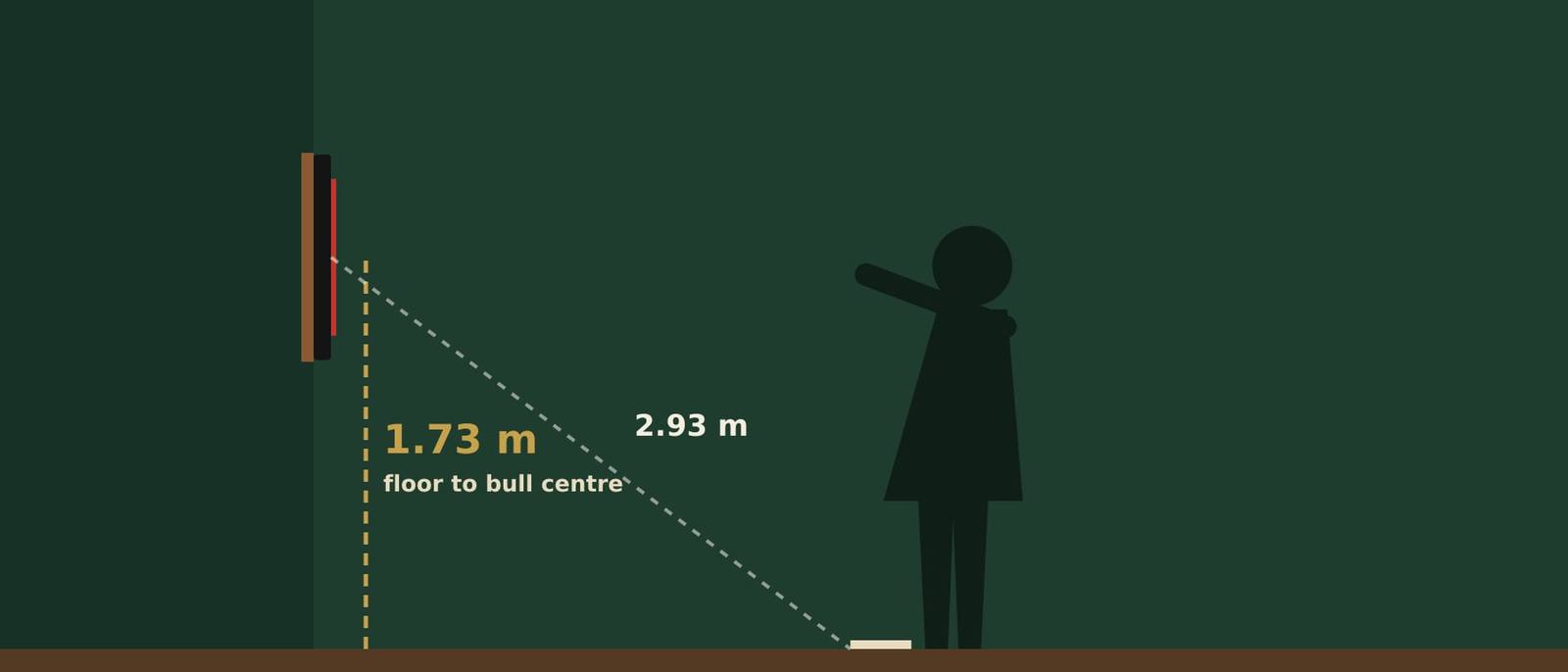
The short answer: hang the board so the centre of the bull is 1.73 m above the floor, and put the throw line 2.37 m from the face of the board. If you want to check your work, the diagonal from the bull to the back of the throw line is 2.93 m. Those three numbers are all you need for a regulation steel-tip setup at home.
The rest of this guide explains exactly where each measurement starts and ends, because that is where most home setups go wrong.
The three measurements at a glance
| Measurement | Metric | Imperial | From | To |
|---|---|---|---|---|
| Board height | 1.73 m | 5 ft 8 in | Floor at the level of the oche | Horizontal line through the centre of the bull |
| Throw distance (steel tip) | 2.37 m | 7 ft 9 1/4 in | Face of the board (plumb line to the floor) | Back edge of the oche |
| Diagonal | 2.93 m | 9 ft 7 3/8 in | Centre of the bull | Back of the oche at floor level |
| Raised oche | 38 mm high, 610 mm long | about 1 1/2 in by 2 ft |
These figures come from the playing rules of the World Darts Federation (WDF), which set out the board height, the throw distance, the diagonal and the size of the raised oche. The same height and distance are used across steel-tip darts, from league nights to the televised tournaments, so a board set up this way at home plays exactly like the one at your local.
Board height: 1.73 m to the centre of the bull
The height is measured from the floor to the centre of the bull, not to the top of the board, not to the bracket and not to the bottom of the cabinet. The WDF wording is precise: the vertical height from the floor, at the same level as the oche, to a horizontal line through the centre of the bull.
That phrase "at the same level as the oche" matters more than it sounds. If you stand on a thick mat or a raised platform to throw, measure from the surface you stand on, not from the floor under it. A 2 cm mat under your feet effectively lowers the board by 2 cm if you ignore it.
How to hang the board at the right height
- Find the centre of the bull on the back of the board. Most bristle boards hang from a bracket screwed to the back, directly behind the bull. If your bracket sits in the middle, the screw for the wall plate goes at 1.73 m. If it is off-centre, measure the distance between the bracket and the centre of the bull and add or subtract it.
- Mark 1.73 m on the wall. Use a tape measure from the floor and a pencil. Then draw a short horizontal line with a spirit level, so you can see whether the bull lines up once the board is on.
- Fit the wall plate and hang the board. Check the 20 is at the top. The WDF rules also ask for the 20 segment to be the darker of the two segment colours, which is how almost every board is printed.
- Measure again with the board on. Put the tape on the floor and read the height at the centre of the bull. Small corrections are easier now than after the throw line is marked.
If the board is going into a cabinet, fit it in the cabinet first and work out where the bull sits relative to the cabinet's fixing points. Then hang the cabinet so the bull ends up at 1.73 m. The cabinet itself can sit wherever that puts it.
Throw distance: 2.37 m from the face of the board
The throw distance is measured horizontally along the floor, from a point directly below the face of the board to the back of the oche. Two details trip people up.
The face, not the wall. A board on its bracket stands off the wall by a few centimetres. A backboard, a cabinet or a thick surround can push it out further. Measuring from the skirting board would put your throw line several centimetres too close. To find the right starting point, hold a spirit level upright against the face of the board, or hang a weight on a string from the centre of the bull, and mark where it meets the floor.
The back of the oche, not the front. The oche has a thickness. Under the WDF rules the 2.37 m runs to its back edge, the side your toes touch. If you use tape, lay it on the board side of your mark so its back edge sits exactly at 2.37 m. With a printed oche mat, line up the back edge of the printed line.
Check it with the diagonal
Floors are not always level, and finding a true vertical below the board face takes a steady hand. The diagonal gives you a second check that does not depend on either. Measure from the centre of the bull, in a straight line, to the back of the oche at floor level. It should read 2.93 m.
This works because the height, the throw distance and the diagonal form a right-angled triangle: 1.73 m up and 2.37 m out gives a diagonal of 2.93 m. If your diagonal is longer, the line is too far back or the board is too high. If it is shorter, the line is too close or the board is too low. Fix the height first, then move the line until the diagonal reads 2.93 m.
It helps to have a second person for this. One holds the end of the tape on the bull, the other walks it down to the floor.
The raised oche
In league and tournament play the throw line is not a painted stripe but a raised oche: a bar 38 mm high and 610 mm long under the WDF rules. Players must not tread on it and must keep their feet behind it. If you throw from the side of the oche, your feet stay behind an imaginary line extending from it on either side.
At home a raised bar is a nice touch rather than a must. What it gives you is feel: you can rest your toes against it without looking down, exactly as you would in a match. A strip of wood screwed to a mat, a rubber threshold strip or a mat with a built-in bar all do the job. A line of tape works too, as long as it stays put and you measure to its back edge.
Soft tip: same height, longer line
Electronic dartboards keep the 1.73 m board height, but many manuals and soft-tip leagues use a throw line of about 2.44 m (8 ft). Some mats print both lines, which is handy if you play on both kinds of board. If you are deciding between the two systems, see Electronic or bristle dartboard?.
How much room you need
The measurements above set the minimum, but you also need space to stand, step back and let someone else throw. As a guide for planning a room:
- Length: 2.37 m from the face of the board to the line, plus a few centimetres for the board standing off the wall, plus at least 60 to 90 cm behind the line to stand and step back. In practice that is about 3 m from the wall. The WDF rules ask an opponent to stand at least 60 cm behind the player at the oche, which is a sensible minimum at home too.
- Width: keep roughly 1 m clear either side of the board. Darts that miss tend to go sideways as well as up and down, and a cabinet with open doors needs width of its own.
- Height: a regulation board is 451 mm across, so with the bull at 1.73 m the top of the board sits at about 1.96 m. Standard ceilings leave plenty of room, but watch out for low beams, sloping loft ceilings and light fittings in the path of your darts.
Keep doors out of the throwing lane. Someone walking into the room between the line and the board is the most common accident with home darts.
Common mistakes
- Measuring the height to the top of the board or to the bracket instead of the centre of the bull.
- Measuring the throw from the wall instead of from the face of the board, especially once the board sits in a cabinet.
- Measuring to the front edge of the tape instead of its back edge.
- Ignoring a thick mat or platform under the thrower when setting the height.
- Hanging the board with a segment other than the 20 at the top after rotating it. Rotate the board, then put the number ring back with the 20 at the top.
- Not checking the diagonal. It takes a minute and catches most of the errors above.
Quick checklist
- Bull centre at 1.73 m above the surface you stand on.
- 20 at the top, board level.
- Throw line 2.37 m from the face of the board to the back of the line (about 2.44 m for soft tip).
- Diagonal 2.93 m from the bull to the back of the line at floor level.
- About 3 m of length and 1 m of clear width either side.
Once the measurements are right, the next steps are protecting the wall and lighting the board. Our guide How to set up a dartboard at home takes you through the whole job, from choosing the wall to marking the line.
Frequently asked questions
How high should a dartboard be from the floor?
The centre of the bull should be 1.73 m (5 ft 8 in) above the floor. Measure from the floor at the level where you stand to throw, up to a horizontal line through the middle of the bull.
How far is the oche from the dartboard?
For steel-tip darts the throw line is 2.37 m (7 ft 9 1/4 in) from the face of the board. The distance is measured horizontally along the floor, from a point directly below the face of the board to the back edge of the oche.
What is the diagonal distance from the bull to the oche?
2.93 m (9 ft 7 3/8 in), measured from the centre of the bull to the back of the oche at floor level. If both the height and the throw distance are right, the diagonal will be too, so it is a useful way to check your setup.
Is the height the same for an electronic dartboard?
Yes, the bull still goes at 1.73 m. The throw line is often different: many soft-tip boards and leagues use about 2.44 m (8 ft). Check the manual that comes with your board.
Should I lower the board for children?
While children are learning, many families hang the board lower or let them throw from closer. That is fine for fun. Once they want to practise properly, move the board back to 1.73 m so their throw develops at the regulation height.