Rules
Dartboard scoring explained: doubles, trebles and checkouts
How dartboard scoring works: the numbers, doubles, trebles and bulls, how to play 501 with a double finish and the bust rule, and the checkouts worth learning.
Darts scoring looks complicated from the sofa and turns out to be simple once you have thrown a few legs. This guide explains what each part of the board is worth, how the standard game of 501 works, what "bust" means, and which checkouts are worth learning first.
The board: what each area scores
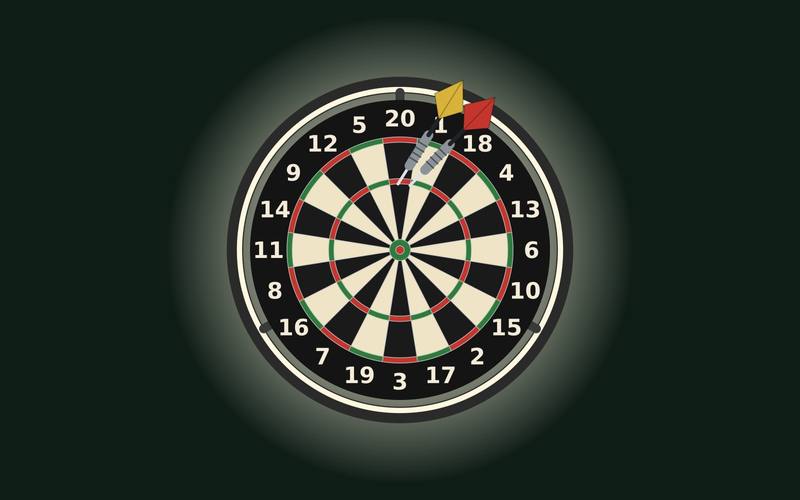
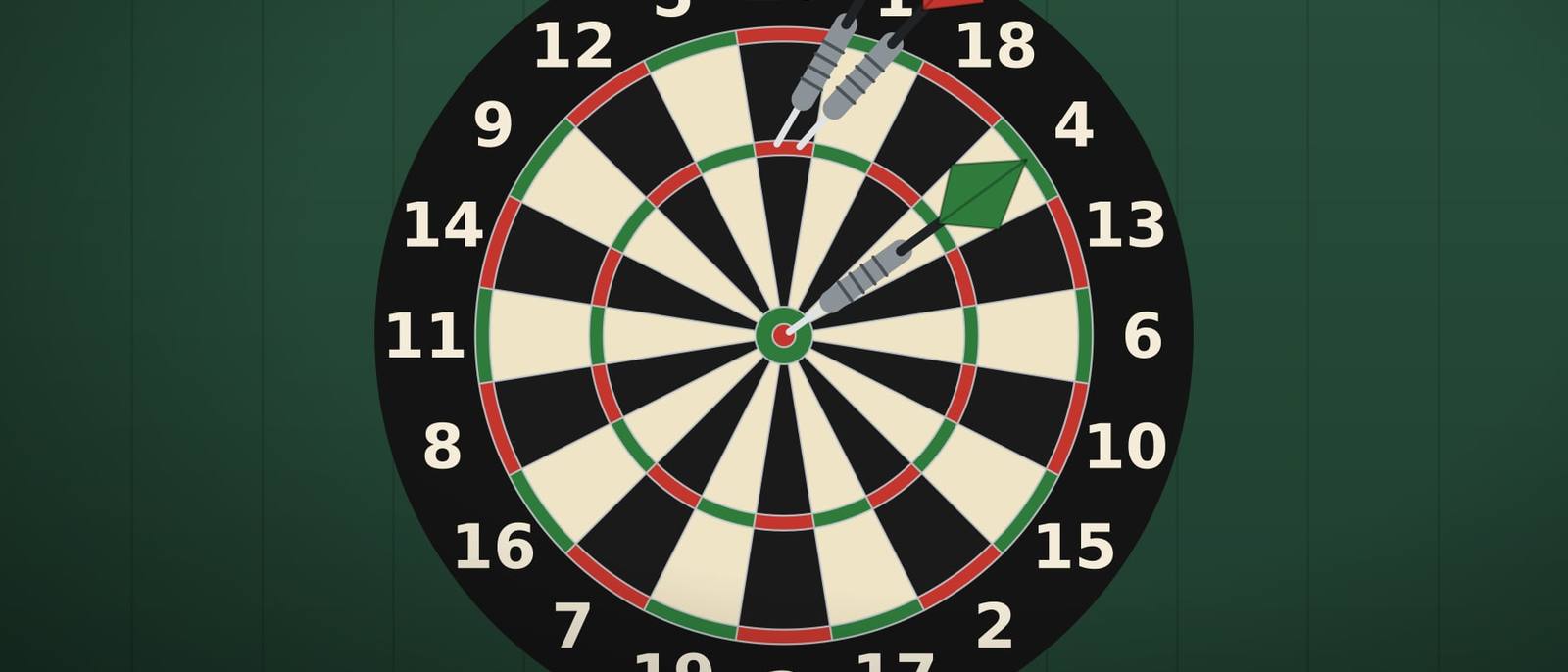
A standard dartboard is divided into 20 numbered segments, arranged around the board in a fixed order. Starting at the top and going clockwise:
20, 1, 18, 4, 13, 6, 10, 15, 2, 17, 3, 19, 7, 16, 8, 11, 14, 9, 12, 5
High and low numbers alternate, so a dart that drifts off the 20 lands in a 1 or a 5. That layout punishes inaccuracy, which is the point.
Each segment is split into rings:
| Area | Where | Score |
|---|---|---|
| Single | The two wide parts of each segment | The segment number |
| Double | The thin outer ring | 2 x the number |
| Treble | The thin inner ring | 3 x the number |
| Outer bull | The green ring around the centre | 25 |
| Bull (bullseye) | The red centre | 50, counts as a double 25 |
| Outside the double wire | The number ring and beyond | 0 |
On a regulation board the double and treble rings are just 8 mm wide inside the wires, according to the World Darts Federation specification, which is why hitting them consistently takes practice.
How a dart is scored
A few rules settle most arguments at home:
- You throw three darts per turn, one at a time.
- A dart scores where its point enters the board. If a dart lands right on a wire, the score is counted from the side of the wire the point went into.
- The dart must stay in the board until the score has been called and written down. A dart that bounces out or falls out before then scores nothing, and you cannot throw it again.
- Do not touch the darts in the board until your turn is over.
The highest scores
The single most valuable target is the treble 20, worth 60. Three darts in it make 180, the maximum for one turn. Not every number between 1 and 60 can be scored with one dart: 23, 29, 31, 35, 37, 41, 43, 44, 46, 47, 49, 52, 53, 55, 56, 58 and 59 are impossible. With three darts, every total up to 162 is possible, but 163, 166, 169, 172, 173, 175, 176, 178 and 179 cannot be scored.
When the treble 20 gets crowded with your own darts, many players switch to the treble 19, which sits at the bottom of the board and is worth 57.
How to play 501
501 is the standard game in pubs, leagues and on television.
- Each player starts on 501. Under WDF rules you start scoring with any dart that lands inside the outer double wire, so no double is needed to start.
- Take turns of three darts. Add up the three darts and subtract the total from your score.
- Finish on a double. To win the leg you must reach exactly zero, and the final dart must land in a double or the bull. If you have 40 left, you need the double 20. If you have 50 left, the bull finishes it.
- Watch out for a bust. If, in a turn, you score more than you have left, reach exactly zero without finishing on a double, or leave yourself on 1 (which cannot be finished), the turn is bust. None of the darts in that turn count and your score goes back to what it was before the turn.
Matches are played over a number of legs, for example best of five, and longer matches are divided into sets of legs.
The fewest darts that can finish a leg of 501 is nine, for example 180, 180 and then treble 20, treble 19, double 12 for the last 141. A nine-dart finish is rare even among professionals.
Checkouts: finishing in three darts or fewer
A checkout is the combination that finishes your remaining score. The highest possible is 170: treble 20, treble 20, bull. With two darts the highest is 110: treble 20, bull. With one dart it is 50, the bull.
Not every score up to 170 can be finished in three darts. The scores that cannot, known as bogey numbers, are 169, 168, 166, 165, 163, 162 and 159. If you are on one of those, the job for the turn is to set up a finish for the next one.
Some common checkouts:
| Score left | One way to finish it |
|---|---|
| 170 | Treble 20, treble 20, bull |
| 167 | Treble 20, treble 19, bull |
| 164 | Treble 20, treble 18, bull |
| 161 | Treble 20, treble 17, bull |
| 160 | Treble 20, treble 20, double 20 |
| 141 | Treble 20, treble 19, double 12 |
| 121 | Treble 20, treble 11, double 14 |
| 100 | Treble 20, double 20 |
| 81 | Treble 19, double 12 |
| 64 | Treble 16, double 8 |
| 50 | Bull |
| 40 | Double 20 |
| 32 | Double 16 |
There are often several ways to finish a score. Players pick routes that leave a good chance if a dart goes into the single instead of the treble.
Good doubles to leave
Experienced players like to leave themselves an even number that can be halved several times, because a miss into the single of the same number still leaves a double:
- 32 (double 16): a single 16 leaves 16, which is double 8. A single 8 leaves 8, which is double 4, and so on.
- 40 (double 20, known as "tops"): a single 20 leaves 20, which is double 10.
- 36 (double 18): a single 18 leaves 18, which is double 9.
Odd numbers cannot be finished with one dart, so if you have an odd score left, use one dart to make it even first. A single 1 on 41 leaves 40, for example.
Keeping score at home
In a match, the marker writes the remaining score on the board and does not tell the player which double to go for. The WDF rules even specify that the caller says "32", not "double 16". At home you can be as helpful as you like.
Ways to keep score:
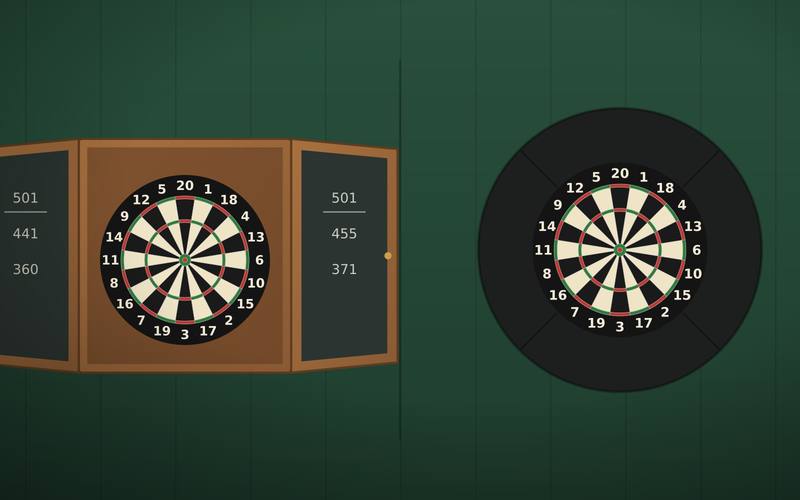
- A chalkboard or whiteboard, often built into the doors of a dartboard cabinet. Write each player's remaining score in a column and cross out the old one.
- An app on a phone or tablet, which does the subtraction for you and suggests checkouts.
- Automatic scoring, either an electronic board for soft-tip darts or a camera kit for steel-tip darts on a bristle board. Electronic or bristle dartboard? compares them.
Other games for the board
501 is not the only game. A few others work well at home:
- 301: the same as 501 but shorter, good for beginners or quick games.
- Around the clock: hit each number from 1 to 20 in order. Simple for children, and good practice for anyone.
- Cricket: players race to hit the 15 to 20 and the bull three times each, scoring on numbers they have closed and their opponent has not. House rules vary, so agree them before you start.
- Killer: each player gets a number and tries to knock out the others by hitting their doubles. Popular at parties, and rules vary from pub to pub.
Getting the board right first
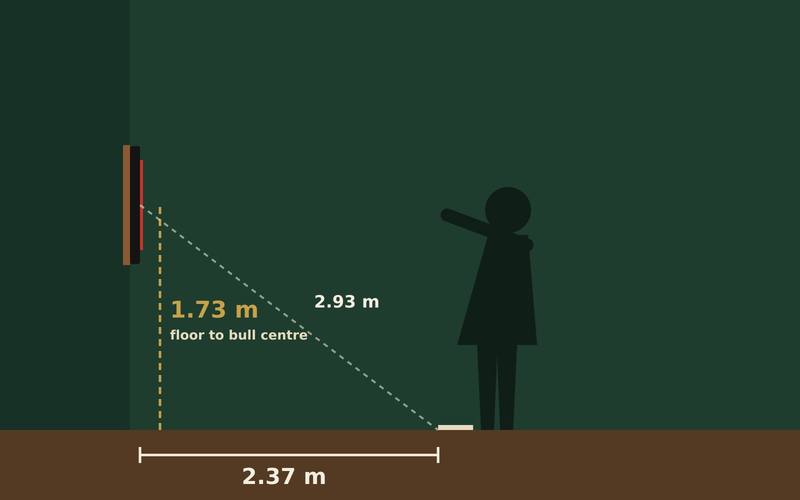
All of this assumes the board is set up properly: the bull 1.73 m above the floor, the throw line 2.37 m from the face of the board and enough light to see the doubles. If your board is not there yet, start with Dartboard height and oche distance and Dartboard lighting.
Frequently asked questions
How does scoring on a dartboard work?
Each of the 20 segments scores its number. The thin outer ring doubles it, the thin inner ring trebles it. The outer bull scores 25 and the inner bull 50. A dart outside the outer wire scores nothing. You throw three darts per turn and add up their scores.
What is the highest score with three darts?
180, from three darts in the treble 20 (3 x 60). The highest single-dart score is also the treble 20, worth 60.
What is the highest checkout in darts?
170: treble 20, treble 20, bull. The bull counts as a double 25, so it can finish a leg. The highest finish with two darts is 110 (treble 20, bull).
What is a bust in darts?
In 501 with a double finish, your turn is bust if you score more than you need, reach exactly zero without finishing on a double, or leave yourself on 1. The darts in that turn do not count and your score goes back to what it was before the turn.
Does the bull count as a double?
Yes. The inner bull scores 50 and counts as a double 25, so you can finish on it from 50. The outer bull scores 25 and is a single.