Buying advice
Electronic or bristle dartboard? Soft tip, steel tip and cameras
Electronic or bristle dartboard? How soft-tip boards and sisal boards differ in darts, scoring, noise and throw distance, and where camera scoring fits in.
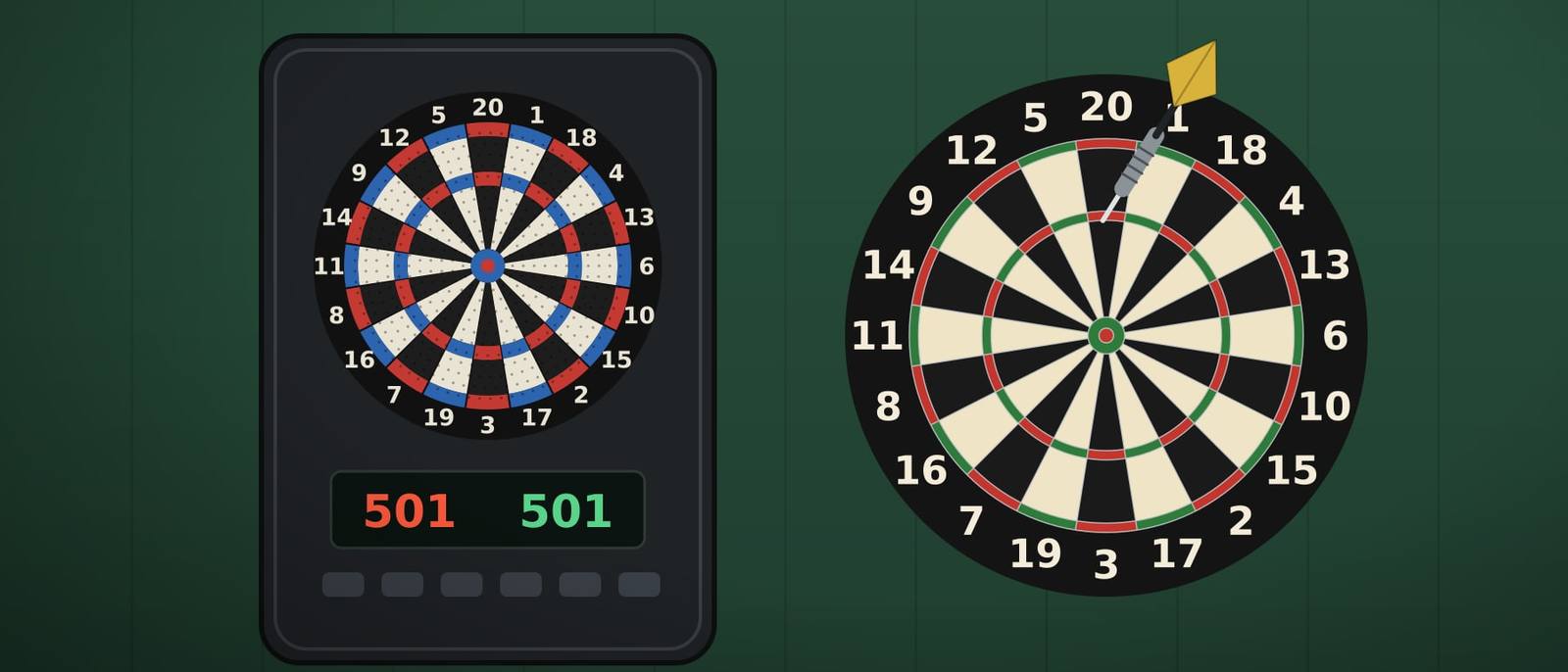
There are two kinds of dartboard for home: the bristle board made of sisal, used with steel-tip darts, and the electronic board with plastic segments, used with soft-tip darts. A third option has arrived in recent years: camera scoring, which adds automatic scoring to a normal bristle board.
Which one is right depends on who will play, what they want from it and where the board will hang.
How a bristle board works
A bristle board is made of sisal fibres, packed tightly and stood on end. A steel point pushes between the fibres, and when you pull the dart out the fibres close up again. Thin metal wires divide the board into segments and rings. You keep the score yourself, on a chalkboard, a whiteboard or an app.
This is the board used in UK pubs, leagues and the major steel-tip tournaments. Its layout and size follow the World Darts Federation specification: 451 mm across, a scoring area of 340 mm between the outer edges of the double wire, and the clock pattern with 20 at the top.
How an electronic board works
An electronic board has segments made of plastic, each full of small holes. A soft-tip dart has a blunt plastic point that sticks in a hole. When it lands, the segment moves very slightly and a sensor behind it records the hit. The board subtracts the score, shows what is left and tells you whose turn it is. Most boards have many built-in games.
Electronic boards need power, from a mains adapter or batteries, and soft-tip darts only.
Side by side
| Bristle board | Electronic board | |
|---|---|---|
| Darts | Steel tip | Soft tip only |
| Scoring | You keep score (or add a camera kit) | Automatic, with display |
| Throw distance | 2.37 m from the face of the board | Often about 2.44 m, see the manual |
| Board height | 1.73 m to the centre of the bull | 1.73 m to the centre of the bull |
| Sound | A dull thud | A sharper click, often with sound effects |
| Power | None | Mains adapter or batteries |
| Wear | Sisal wears around the 20, rotate the board | Soft tips break and are replaced, segments can wear |
| Feel | The same as pubs and steel-tip leagues | Different darts and a different landing |
| Board size | Regulation 451 mm, 340 mm scoring area | Varies by model |
The case for bristle
- It is the real thing. If you play, or want to play, in a UK pub or league, a bristle board at home means you practise with the same darts, the same distance and the same feel.
- Steel-tip darts. Steel-tip darts can be heavier, up to 50 g under WDF rules, and come in a huge range of weights and grips. Most players settle on a set and stick with it.
- Quieter. A steel tip going into sisal makes a soft thud.
- No power, no electronics. Nothing to break, nothing to charge.
- It works with every accessory. Standard cabinets, surrounds and ring lights are built around the 451 mm bristle board.
The downside is that you keep score yourself. For some that is part of the game. For families and mixed groups, it can slow things down.
The case for electronic
- Automatic scoring. Nobody needs to do mental arithmetic, which makes it easy for anyone to join in.
- Lots of games. Beyond 501 and 301, most boards include practice and party games with the rules built in.
- Soft tips. A plastic point is blunter than a steel one. Darts are still darts and need supervision, but bounce-outs are less likely to dent a floor.
The trade-offs:
- Soft-tip darts only. Your steel-tip darts stay in the case.
- Louder. Plastic on plastic is sharper than steel on sisal.
- Different distance and target. Many soft-tip boards use a throw of about 2.44 m, and the size of the scoring area varies by model. Many follow a larger soft-tip size, so practice does not carry over exactly to a bristle board.
- Wear and parts. Soft tips break now and then and need replacing. Segments can wear or stick over time.
The third way: camera scoring
Camera scoring kits mount three or four small cameras around a standard bristle board, usually in an LED ring. After a one-off calibration, software on a phone, tablet or computer works out where each dart has landed and keeps the score.
That gives you:
- steel-tip darts on sisal, at the regulation 2.37 m
- automatic scoring, with averages and checkout suggestions in the software
- an evenly lit board, thanks to the LED ring
The things to check: camera kits work with bristle boards only, not electronic boards. They need space around the board for the camera ring, which can be tight in a cabinet. And they need power and a device to run the software.
For many players, camera scoring is the best of both: the feel of a pub board and the convenience of an electronic one. It is also the larger investment of the three.
Which one suits you?
A bristle board is the better choice if:
- you play or want to play steel tip in a pub or league
- you want the widest choice of darts and accessories
- the board will be in a flat or a quiet house
An electronic board is the better choice if:
- the board is mainly for families, children or parties
- nobody wants to keep score
- you play soft tip already, or soft-tip leagues are what is available to you
A bristle board with camera scoring is the better choice if:
- you want automatic scoring but practise for steel-tip matches
- you like statistics and tracking your averages
- you have space around the board for the camera ring
Darts for each board
Steel-tip and soft-tip darts are not interchangeable without changing the point. Soft-tip darts are generally lighter than steel-tip darts. Steel-tip darts come in a much wider range of weights, and many players experiment before settling on a set.
Some darts are sold as convertible, with screw-in points so the same barrels can be used on both kinds of board. If you plan to play on both, it is worth looking for those. Otherwise, keep a set for each board and do not mix them up: a steel point thrown at an electronic board can damage it in one throw.
Noise and neighbours
If the board shares a wall with a neighbour, think about sound as well as looks. The impact of a dart travels through a wall, whatever the board. A bristle board fixed on a solid wall, with a cork backboard behind it, is the quieter choice. Electronic boards add a sharper click on impact and often sound effects, though many let you turn the volume down or off.
Setting up either board
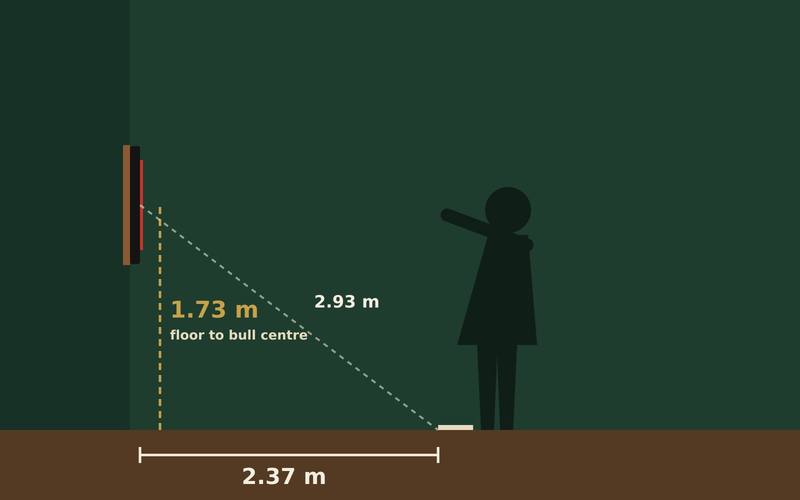
The setup rules are the same in principle. Hang the board so the centre of the bull is 1.73 m above the floor. Mark the line at 2.37 m for steel tip, or at the distance in your manual for soft tip, measured from the face of the board. Protect the wall with a surround, backboard or cabinet, and light the board evenly. How to set up a dartboard at home covers each step. Many oche mats print both the 2.37 m and the 2.44 m lines.
New to keeping score? Start with Dartboard scoring explained, then decide how much of it you want a machine to do for you. Our electronic dartboards and camera scoring category has both options.
Frequently asked questions
Can you use steel-tip darts on an electronic dartboard?
No. Electronic boards are made for soft-tip darts. Steel points can crack the plastic segments and damage the sensors behind them.
Is an electronic dartboard good for practice?
It is good for practising scoring and finishing, because the board keeps count and many have training games. If you play steel tip in a league, practise on a bristle board at 2.37 m so the feel, the weight of the darts and the distance match your matches.
Are electronic dartboards loud?
Louder than bristle. A soft-tip dart hitting plastic makes a sharper sound than a steel tip going into sisal, and many boards add sound effects. In a flat with thin walls, a bristle board with camera scoring may be the quieter way to get automatic scoring.
What is the throw distance for soft-tip darts?
Many soft-tip boards and leagues use about 2.44 m (8 ft) from the face of the board. Steel tip uses 2.37 m. The board height is 1.73 m to the centre of the bull for both.