Buying advice
Dartboard cabinet or surround: which one do you need?
Dartboard cabinet or surround? How much wall each protects, the space they need, scoreboards, lights and camera kits, and which suits your room and players.
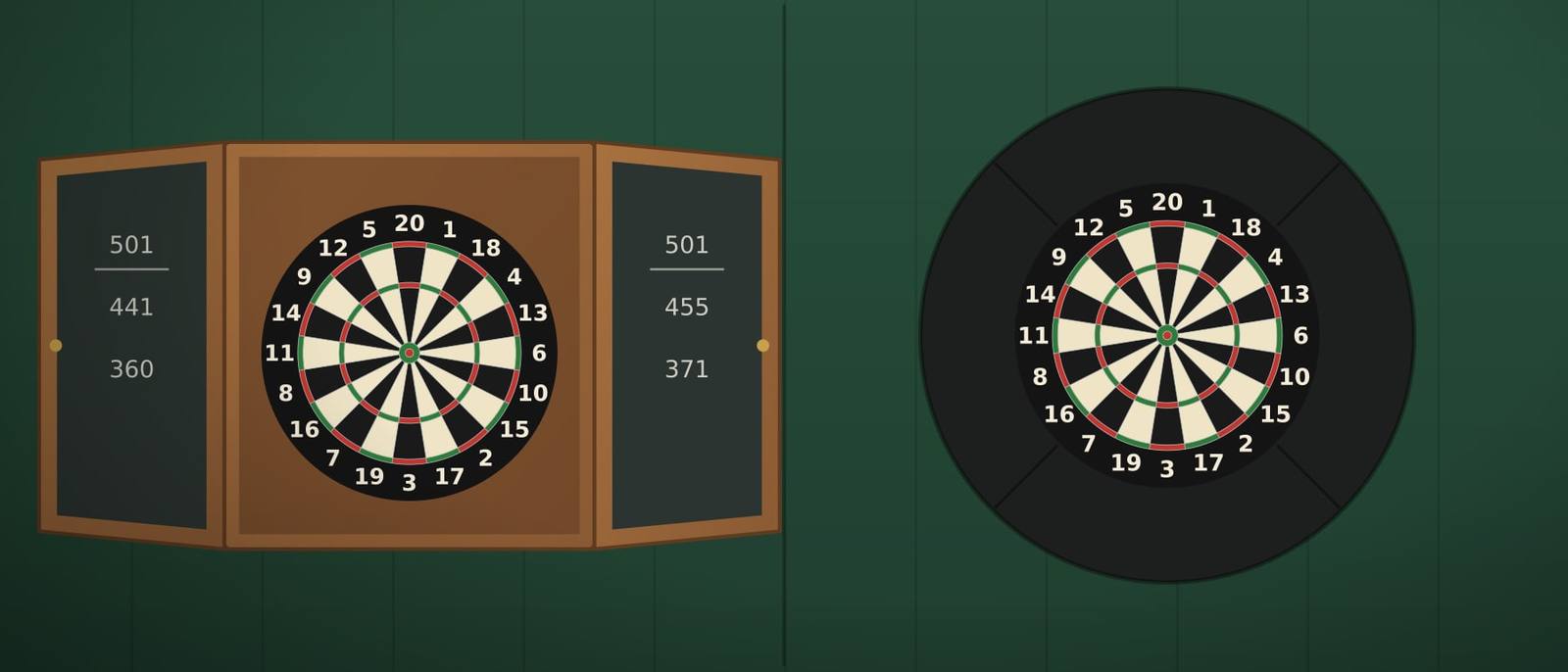
Both do the same basic job: they stop steel-tip darts from ending up in your wall. Where they differ is how much wall they protect, how much room they take, and what the setup looks like when nobody is playing.
The short version: a surround is the simple, low-cost option for players who mostly hit the board. A cabinet protects more wall, keeps score in its doors and turns the board into furniture, which suits family rooms and living spaces. A backboard sits between the two and can be combined with either.
Side by side
| Surround | Cabinet | Backboard | |
|---|---|---|---|
| What it is | Foam or rubber ring around the board | Backboard plus two doors | Large panel behind the board |
| Protects | A ring of wall just outside the board | The area inside the cabinet | A large area around the board |
| Extra fixings | None, held by the board | Several, into solid wall or studs | Usually several |
| Scoreboards | No | Yes, in the doors | No |
| When not in use | Board on show | Doors closed, board hidden | Board on show |
| Wall width needed | Little more than the board | About twice the closed width with doors open | As wide as the panel |
| Works with a ring light | Usually | Often, check the inner size | Yes |
| Works with camera scoring | Usually | Only if there is room for the camera ring | Yes |
What a surround does well, and what it does not
A surround is a ring, usually in four pieces, that clips together around a standard 451 mm bristle board. The board holds it in place, so the only fixing in the wall is the board bracket you already have. It catches the darts that land just outside the double, which are most of the misses for a reasonably consistent player.
The other benefit is easy to overlook: a dart that hits a soft surround keeps its point. A dart that hits brick or the metal edge of a cabinet can blunt or bend its tip, and burred points cause more bounce-outs.
What a surround does not do is catch wide misses. A dart that clears the ring goes into the wall. For an experienced player in a garage or a games room, that rarely happens. With beginners, children or a group of friends at Christmas, it happens every evening.
Surrounds also leave the board in view all the time. Some people like that, it looks like a darts room. In a living room it may not suit everyone.
What a cabinet does well, and what it does not
A cabinet frames the board with a backboard and two doors. Darts that miss the board land in the backboard rather than the wall. The doors usually carry chalkboards or wipe-clean panels for keeping score, so you do not need a separate scoreboard. When the game is over you close the doors, and the board, the chalk and often the darts are put away in one piece of furniture.
That makes a cabinet the natural choice for:
- living rooms and family rooms, where the board should not be on show all the time
- homes with children, because closed doors keep the board and darts out of reach
- anyone who wants the pub look, with wood and chalkboards
The trade-offs:
- Width. With both doors open, a cabinet needs about twice its closed width. Check the space before you buy, including door frames and corners.
- Fixings. A cabinet with a board inside is heavy, and it takes the impact of every dart. It needs solid fixings: plugs and screws in brick or block, studs or rated cavity fixings in plasterboard.
- Hard edges. A dart that hits the frame or a door edge can bounce out or blunt its point. The backboard covers the area right around the board, but not the frame.
- Board face position. The cabinet holds the board out from the wall, so the throw line has to be measured from the face of the board. More on that in Dartboard height and oche distance.
Backboards: the extra layer
A backboard is a large panel, often cork, foam or soft board, fixed to the wall behind the dartboard. It catches the wide misses a surround lets through. You can buy one or make one, as long as the material lets a dart stick in rather than bounce off. Hard materials like MDF or plywood are a poor choice on their own because darts bounce back off them.
A surround in front of a backboard covers most situations in a games room or garage: the surround takes the near misses, the backboard takes the rest.
Lights and camera kits
If you plan to add a ring light, check the fit with whatever protects the wall. Most ring lights fix to the board bracket and sit just outside the number ring. With a surround that is usually straightforward. Inside a cabinet, the light adds to the width and depth around the board, so compare the cabinet's inner size with the ring's diameter before buying both. Some cabinets have an LED strip built into the top instead.
Camera scoring kits mount cameras around the board, usually on their own LED ring. They need clear space around the board for the cameras to see it, which can be tight in a cabinet. A surround or a backboard leaves more room.
Which one should you choose?
Choose a surround if:
- the players are mostly experienced and miss by small margins
- the board is in a garage, a shed or a games room where looks matter less
- you want to keep drilling to a minimum
- you plan to add camera scoring
Choose a cabinet if:
- the board is in a living room or a shared space
- children or beginners play, or you host darts nights
- you like keeping score on the board itself
- you want the board out of sight when it is not in use
Combine a surround and a backboard if:
- you want the most wall protection without the width of a cabinet
- you want to keep the board on show
Choose a free-standing stand if:
- you cannot drill at all, for example in a rented flat
- the board has to move between rooms or be packed away
A stand usually comes with a surround and sometimes a light. Put it in front of a wall or a heavy piece of furniture that can take the odd stray dart, never across a doorway.
A note on repairs
If your wall already has dart holes, small holes in plaster can be filled and painted over before you put up the new setup. Do it before the cabinet or backboard goes up, so the wall behind is sound.
Next steps
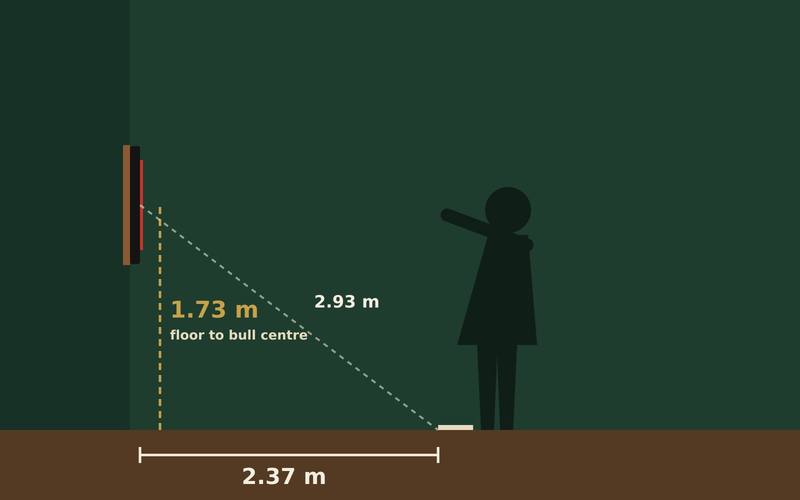
Once you have chosen the protection, the rest of the setup follows: hang the board at 1.73 m to the centre of the bull, light it, and mark the throw line at 2.37 m. How to set up a dartboard at home takes you through each step. You can browse dartboard cabinets and dartboard surrounds, or look at a complete setup with all the parts sized to fit together.
Frequently asked questions
Is a dartboard surround enough to protect the wall?
For players who rarely miss the board by much, yes. A surround catches darts that land just outside the double. Beginners, children and guests miss by more, so in a family room add a backboard behind the surround or choose a cabinet.
Do I measure the throw distance from the cabinet or the board?
Always from the face of the board. A cabinet holds the board a few centimetres in front of the wall, so measure 2.37 m from the board face to the back of the throw line, not from the wall or the cabinet.
Can I use a surround inside a cabinet?
Usually there is no need, because the cabinet has its own backboard. Some players fit a slim surround anyway for extra protection around the board, but check that the cabinet is deep and wide enough first.
Which is better for a rented home?
A surround needs no extra holes beyond the board bracket, and a free-standing stand needs none at all. A cabinet needs several solid fixings. If you cannot drill, a stand with a surround is the easiest option.